
March 28, 2026
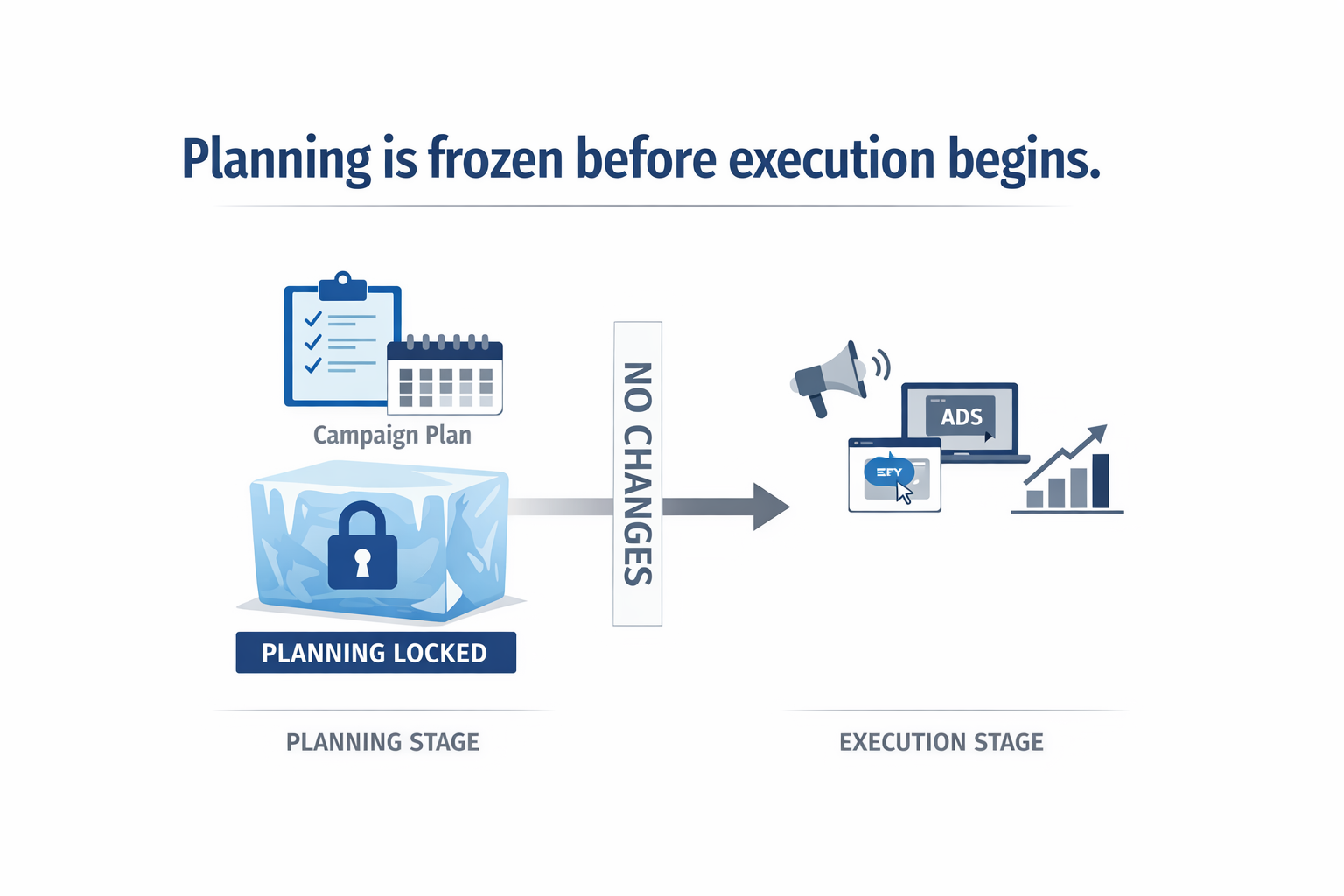
Most people believe campaigns fail during execution. They don’t. They fail before execution begins — when planning decisions are informal, budgets are editable, and approvals are unclear. By the time ads go live, the real damage is already done:
Execution platforms can’t fix this because execution is not the root problem. The root problem is decision integrity. If you cannot answer: – Who approved this? – On which version? – With what budget logic? – At what point in time?
Then you don’t have a campaign plan. You have a story written after the fact. Campaign planning is not a creative exercise. It is a governance function. And governance cannot be retrofitted after execution starts.
Most people believe campaigns fail during execution. Bad creatives. Wrong targeting. Poor optimization. A platform algorithm that didn’t behave as expected. That’s the story we usually tell. It’s comforting, because execution failure feels fixable. You can tweak, reallocate, optimize, pause, restart. There’s motion. There’s activity. There’s something to do. But after watching enough campaigns up close — especially large, high-pressure ones — a different pattern becomes obvious.
Most campaigns don’t fail during execution. They fail before execution begins. They fail quietly, politely, and structurally — long before the first ad is served.
Picture a familiar scene. A campaign plan is “almost final.” The deck has been circulated. The spreadsheet looks clean enough. Everyone has glanced at it at least once. There’s no formal moment where planning ends. It just… fades. Someone says, “We’ll adjust if needed.” Another person says, “Let’s stay flexible.” Budgets are left editable “just in case.” Approvals are implied, not recorded. No one objects, because no one wants to be the bottleneck.
Execution begins. From the outside, everything looks normal. Ads go live. Reports are generated. Performance is discussed. But underneath, something has already fractured.
By the time execution starts, the real damage is usually already done:
Weeks later, when results disappoint, the questions begin:
“Why did we allocate so much to this channel?” “I thought that was approved differently.” “That wasn’t the version I signed off on.” “We changed that based on feedback, remember?” And suddenly, no one can answer the most basic questions with confidence. Not because people are dishonest — but because the system never required clarity.
Here’s the uncomfortable truth: Execution platforms are very good at executing. They are terrible at protecting decisions. They assume that planning is already sound. They assume:
But those assumptions are almost never true in real agency environments. When planning decisions are informal, execution tools simply amplify the ambiguity at scale. They don’t fix the problem. They industrialize it.
The core issue isn’t performance. It’s decision integrity. Decision integrity means that for any campaign decision, you can clearly answer:
If you cannot answer those questions cleanly, you don’t have a campaign plan. You have a narrative reconstructed after the fact. And post-hoc narratives are incredibly convincing — especially to ourselves.
One of the most dangerous words in campaign planning is flexibility. Flexibility sounds mature. Reasonable. Strategic. But in practice, flexibility often becomes a euphemism for:
When everything is flexible, nothing is owned. When plans can always be changed, no decision ever truly exists. And when no decision truly exists, accountability becomes impossible — because accountability requires something fixed to point at.
This is where many teams get uncomfortable. Campaign planning feels creative. Collaborative. Iterative. But planning itself is not creativity. Planning is governance. It is the act of turning intent into structure:
Creativity thrives inside constraints. Execution thrives after structure exists. But governance must come first. You cannot retrofit governance after execution starts any more than you can install seatbelts after a crash.
When governance is missing upfront, teams try to recreate it later. They add explanations. They annotate decks. They reconstruct timelines. They argue about “what was known at the time.” This is expensive. Not just financially — but culturally. Because once governance becomes retroactive:
All of this could have been avoided by one simple discipline: freezing planning before execution.
Freezing planning does not mean being rigid forever. It means:
Changes can still happen. But they happen consciously, not casually. They create new versions. They surface trade-offs. They force clarity. That’s not bureaucracy. That’s professionalism.
Senior practitioners often arrive at this realization the hard way. After enough post-mortems. After enough budget disputes. After enough “we’ll do better next time” conversations. They stop asking, “How do we execute faster?” And start asking, “How do we protect decisions?” Because speed without integrity is just chaos at scale.
Mature teams can tell you:
Fragile teams rely on memory, goodwill, and improvisation. Both can launch campaigns. Only one can survive pressure.
So here’s the question that actually matters — not just for agencies, but for any team running high-stakes campaigns: At what point do you consider planning “final”? Not “mostly final.” Not “good enough.” Not “we’ll adjust later.” Final.
If the answer is “never,” then execution is already carrying more risk than you realize.
Execution is visible. Planning discipline is invisible. Decision integrity is silent — until it’s missing. And by the time execution exposes it, it’s usually too late.